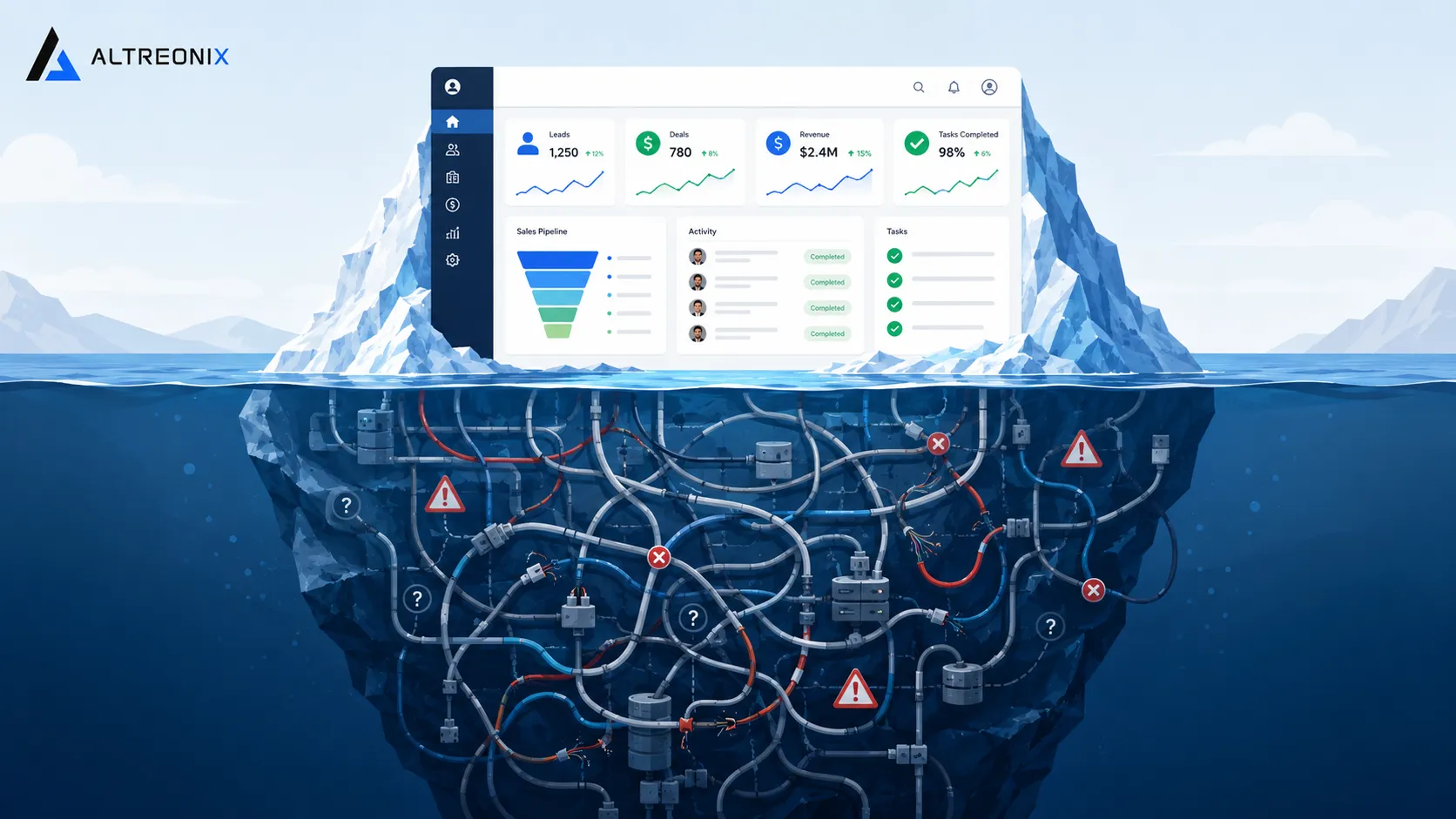
The Stat Everyone Quotes and Nobody Explains
If you’ve spent any time researching CRM failure, you’ve run into the same number over and over. Somewhere between half and most CRM projects fail. It shows up in vendor blogs, agency pitches, and LinkedIn posts, usually attached to a single citation and nothing else.
What almost nobody tells you is that this number has been measured a dozen different ways over two decades, by different firms, using different definitions of “failure.” Some of them are measuring total abandonment. Some are measuring a CRM that’s technically still running but never delivered what it was supposed to. Those are not the same problem, and they don’t call for the same fix.
We wrote our pillar guide on custom versus off-the-shelf CRM around this failure risk, and our breakdown of custom CRM costs touches on it too. This post is where we actually unpack it, because knowing the real causes changes what you do about it, whether you’re on Salesforce, HubSpot, or something we’re building for you from scratch.
The Failure Rate Depends on Who’s Counting, and How
Here’s the range as it’s actually been reported, going back over 20 years.
| Year | Source | Reported Failure Rate |
|---|---|---|
| 2001 | Gartner Group | 50% |
| 2002 | Butler Group | 70% |
| 2002 | Selling Power / CSO Forum | 69.3% |
| ~2010s | Forrester | 47% |
| 2018 | Small Business Genius | 18% to 69% |
| 2025 | Johnny Grow (synthesis of prior analyst research) | 55% |
That’s not a typo, the range genuinely spans from 18% to 70% depending on the year and the source. Johnny Grow’s 2025 synthesis of failure-rate research pulls together the Gartner and Forrester figures and lands on 55% as the most defensible current estimate, but even that number is an aggregate of studies that weren’t measuring the exact same thing.
The wide spread comes down to definition. Some studies count a CRM as failed only if it’s abandoned outright. Others count it as failed if it didn’t meet its original business case, even if people are technically still logging in. A CRM where half the sales team quietly keeps a shadow spreadsheet isn’t abandoned, but it’s also not doing its job. Most of the failure that actually costs SMBs money looks like the second kind, not the first.
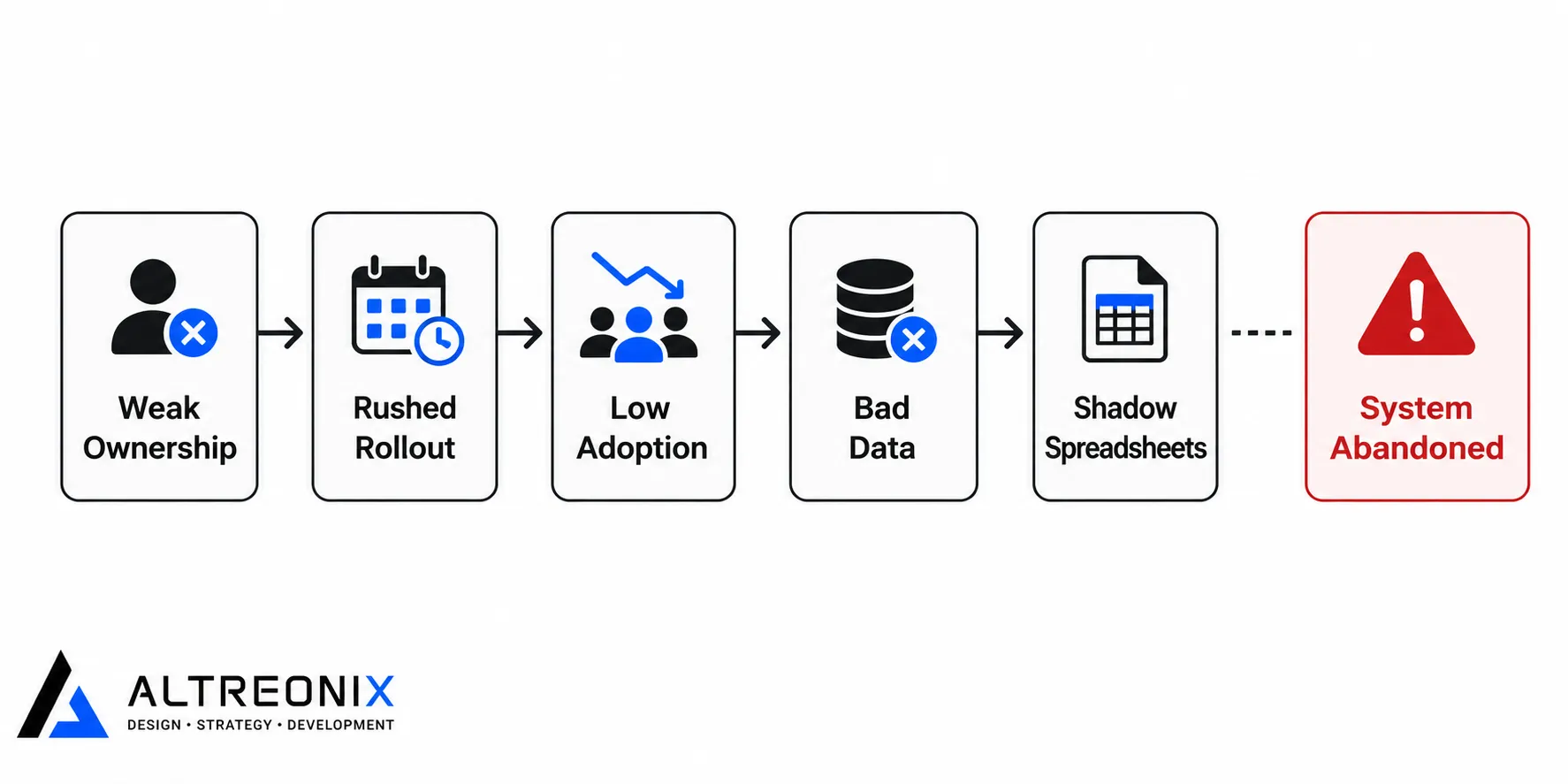
The Six Things That Actually Cause CRM Failure
Most articles stop at “poor change management” and move on. That’s true, but it’s also vague enough to be useless. Here’s what it actually looks like in practice, based on where we see CRM projects go sideways and what the research consistently points to.
1. Nobody senior actually owns the rollout
Forrester’s research on CRM change management is blunt about this. CRM struggles usually trace back to a company treating it as an IT deployment rather than a change in how people work. If the project is owned by whoever set up the account rather than someone with authority over the sales or operations process, adoption enforcement never happens, and the system decays within a few months.
2. The rollout gets rushed to hit a deadline
Training gets compressed into a single session. Data migration happens over a weekend instead of being validated properly. Nobody checks that the pipeline stages actually match how deals really move. Speed feels like progress, but it’s usually what turns a fixable problem into a permanent one.
3. The workflow doesn’t match the tool
This is the one we see most often with SMBs specifically. Generic CRMs assume a linear pipeline: lead, qualified, proposal, closed. If your business tracks production orders, shipments, or ongoing engagements instead of one-time deals, the platform’s data model fights you at every step, and the team eventually stops fighting back and just works around it.
4. Data quality decays because nobody owns it
A CRM is only as useful as the data in it. Without a clear owner responsible for data hygiene, duplicate records pile up, fields go unfilled, and within a year the reports coming out of the system are guesses dressed up as dashboards. Once people stop trusting the data, they stop entering good data, which makes the problem worse.
5. Integrations get built without anyone owning the process behind them
This one’s worth its own section, because it’s the least understood cause and the one competitor content almost never covers properly.
6. Heavy customization turns an off-the-shelf platform into an unmaintainable custom system, minus the benefits of actually being custom
Also worth unpacking separately below, because it’s a specific trap that catches growing SMBs more than anyone else.
 ## “It Technically Works” Is Not the Same as “It Works”
A Reddit thread from CRM practitioners put this better than most consulting reports do. A lot of CRM integrations get the data flowing correctly and still fail, because the workflow behind that data was never designed properly, and nobody was assigned to own it.
This is a genuinely different failure mode from a broken integration. The API connection works. Records sync. Fields populate. And the CRM still fails, because syncing data correctly is not the same as designing the right process around who updates what, when, and who’s accountable when something looks wrong.
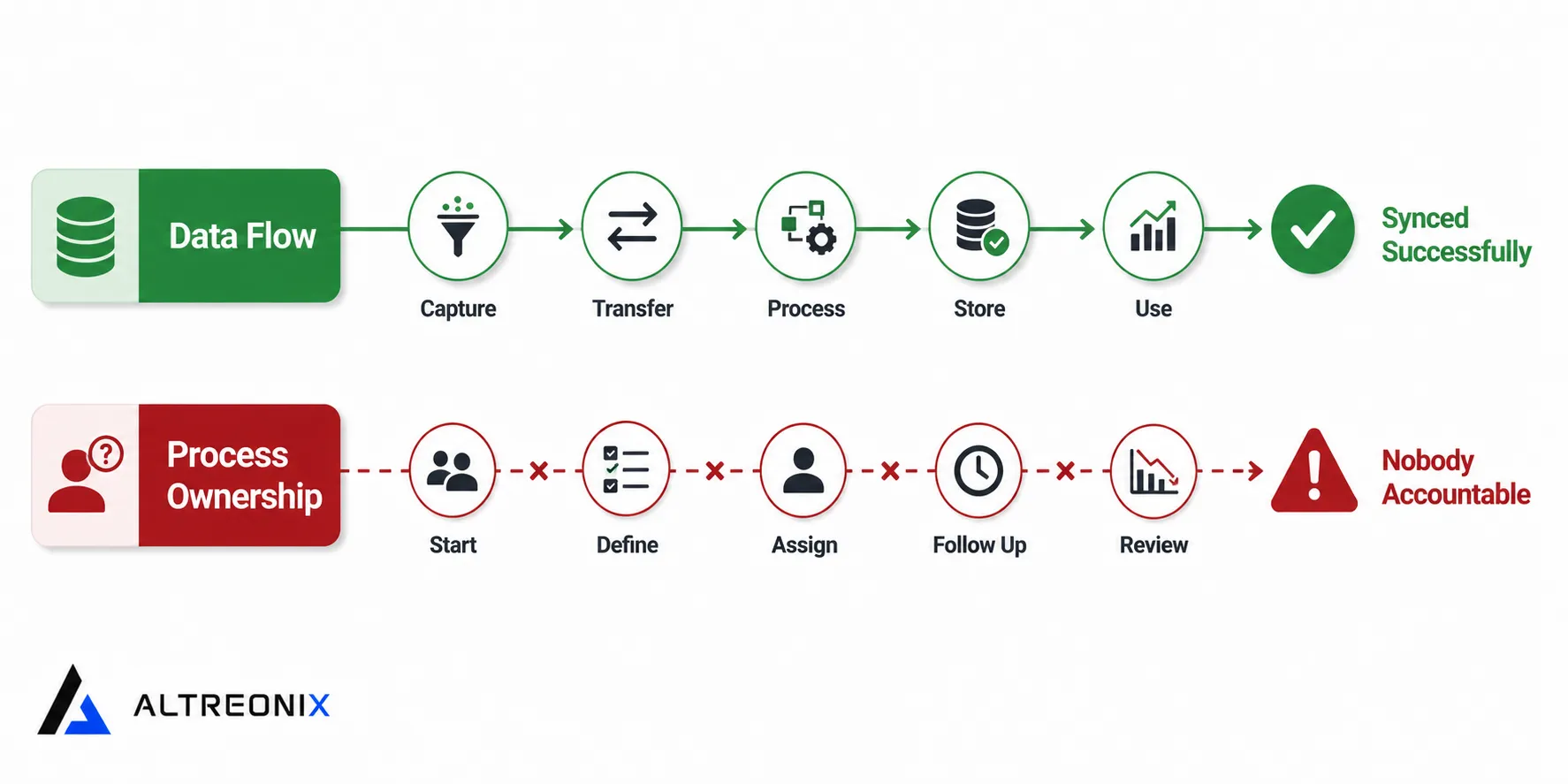 This shows up constantly in the pain points teams describe. A Reddit thread on CRM integration pain points surfaces the same handful of issues repeatedly: duplicate records from imperfect syncs, email logging that catches some threads and misses others, and automated sequences that fire based on stale data. None of these are technical failures in the sense of “the integration is broken.” They’re process failures wearing a technical disguise.
Compliance-constrained environments make this even more visible. One Reddit discussion on CRM integrations under CMMC Level 2 describes teams limited to a narrow set of approved integrations because of cloud data-residency requirements, forcing manual workarounds that reintroduce the exact duplicate-data and ownership problems a CRM was supposed to eliminate. If your business has any regulatory or data-residency constraints, this is worth mapping out before implementation, not after.
The Over-Customization Trap
There’s a specific pattern we see with SMBs that grow fast on an off-the-shelf CRM: they customize it so heavily, adding custom fields, workflow rules, and third-party plugins, that it stops behaving like the platform they bought and starts behaving like a fragile, undocumented custom system, without any of the benefits of one.
One Reddit account from an agency owner described this directly: what started as an affordable, quick-to-deploy platform slowly turned into what they called a tax on the business’s growth, every new hire needed extensive training just to understand the custom logic layered on top, and every plugin update risked breaking something nobody fully understood anymore.
This is the failure mode that off-the-shelf vendors rarely warn you about, because it doesn’t show up in the first year. It shows up two or three years in, once enough workflow patches have accumulated that the system is neither simple to use nor properly architected. It’s also the single most common reason SMBs end up talking to a studio like ours in the first place, not because off-the-shelf CRM is bad, but because their specific instance of it has become unmanageable.
Early Warning Signs Your CRM Is Already Failing
Failure rarely happens all at once. It shows up gradually, and most of these signs are visible well before the system gets abandoned.
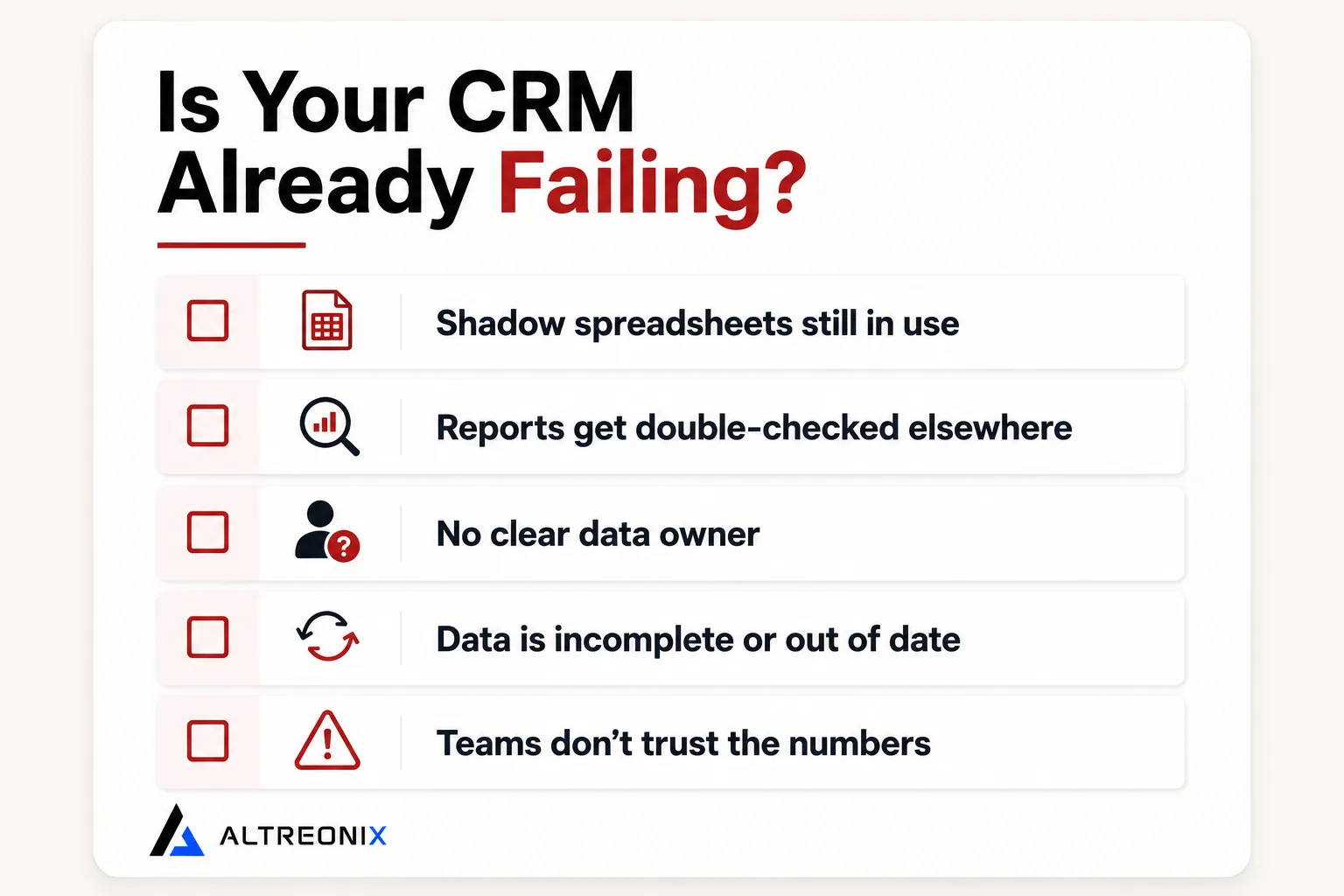 - Sales or ops team members keep a personal spreadsheet “just to be safe”
- Reports from the CRM regularly get double-checked against another source before anyone trusts them
- New hires take unusually long to get comfortable with the system, longer than the tool itself should require
- Nobody can say, without checking, who owns data quality in the CRM
- Every new integration or automation request comes with “let’s see if it breaks anything else”
- Custom fields or workflow rules have been added by more than one person with no shared documentation
If two or more of these sound familiar, the CRM isn’t failed yet, but it’s on the path, and it’s worth addressing the root cause now rather than waiting for a full rebuild to become the only option.
CRM Still Delivers Strong ROI When It’s Done Right
None of this is an argument against CRM. It’s an argument against sloppy implementation. Where CRM is implemented with real ownership and a workflow that fits, the return is well documented. Broader CRM statistics research for 2026 puts average ROI at roughly $8.71 for every $1 spent, and a HubSpot and IDC study found ROI reaching around 505% over three years for well-run deployments, with payback periods under four months in some cases.
McKinsey’s research into sales automation makes a similar point from a different angle: automation and better process design, not the software itself, are what actually reduce the cost of sales and free up time for revenue-generating work. The technology is rarely the bottleneck. The process wrapped around it is.
Does Custom CRM Fail Less Often Than Off-the-Shelf?
Not automatically, and we’d be lying if we said otherwise. A custom CRM built without proper discovery, clear ownership, and a realistic rollout plan fails for exactly the same reasons an off-the-shelf implementation does. What changes with custom development is the type of risk, not whether risk exists.
Off-the-shelf failure is mostly a workflow-fit and adoption problem, the tool doesn’t match the process, so people route around it. Custom failure is mostly a scope and build-quality problem, if requirements weren’t mapped properly upfront, the system gets built around the wrong assumptions from day one. This is exactly why we treat discovery and workflow mapping as a distinct, paid phase before any development starts, it’s the single biggest lever against custom CRM failure, the same way strong change management is the biggest lever against off-the-shelf failure.
Conclusion
The headline failure-rate number isn’t wrong, but it’s also not the useful part of the story. What matters is that CRM failure has specific, repeatable causes: weak ownership, rushed rollouts, workflows that don’t match the tool, data nobody’s accountable for, integrations built without process design behind them, and off-the-shelf systems customized past the point of manageability. Every one of these is preventable with the right groundwork, regardless of which platform or build approach you choose.
If any of the early warning signs above sound familiar, it’s worth mapping out where the actual breakdown is happening before deciding whether the fix is a process change, a rebuild, or something in between. Our internal software and business systems team can help you figure out which one it actually is.