Introduction
Here’s a stat that should make any founder pause before signing off on an “AI agent” project: analysts expect a large share of agentic AI initiatives to be cancelled within the next couple of years, not because the technology fails, but because the projects themselves were never set up to succeed in the first place. That’s not a knock on AI. It’s a knock on how these projects usually get started.
We’ve watched this pattern up close while building automation and AI tooling for small businesses. The failures almost never come from the model being “not smart enough.” They come from four very avoidable setup mistakes, made before a single line of the actual solution gets built. This post is about naming those traps clearly enough that you can spot them in your own plans before they cost you anything.
If you haven’t already, it’s worth reading our full comparison of AI agents vs automation first, since a lot of what gets labeled a “failed AI project” is actually a mismatch problem: someone built an agent for a task that only ever needed a simple automation, or vice versa. This post assumes you’ve already got the right tool in mind and focuses on the execution traps that sink it anyway.
The Gap Between Adoption Headlines and Real Outcomes
The headlines make this sound like a solved problem. Most companies now use AI in at least one business function, and a solid majority are actively experimenting with agents specifically, according to recent survey data. That part is true and worth taking seriously, AI agents are not a fringe experiment anymore.
What the headlines leave out is the second half of the picture: only a small fraction of those experimenting companies have actually gotten an agent scaled and running reliably. Most are still stuck in pilot mode, and a meaningful chunk of pilots never make it past that stage at all. The gap between “we’re experimenting with agents” and “this agent is actually running our business” is where almost every failure story in this space actually lives.
That gap isn’t a technology problem. It’s a project-setup problem, and it shows up in four specific, repeatable ways.
Trap 1: Starting With a Vague Goal Instead of a Measurable Workflow
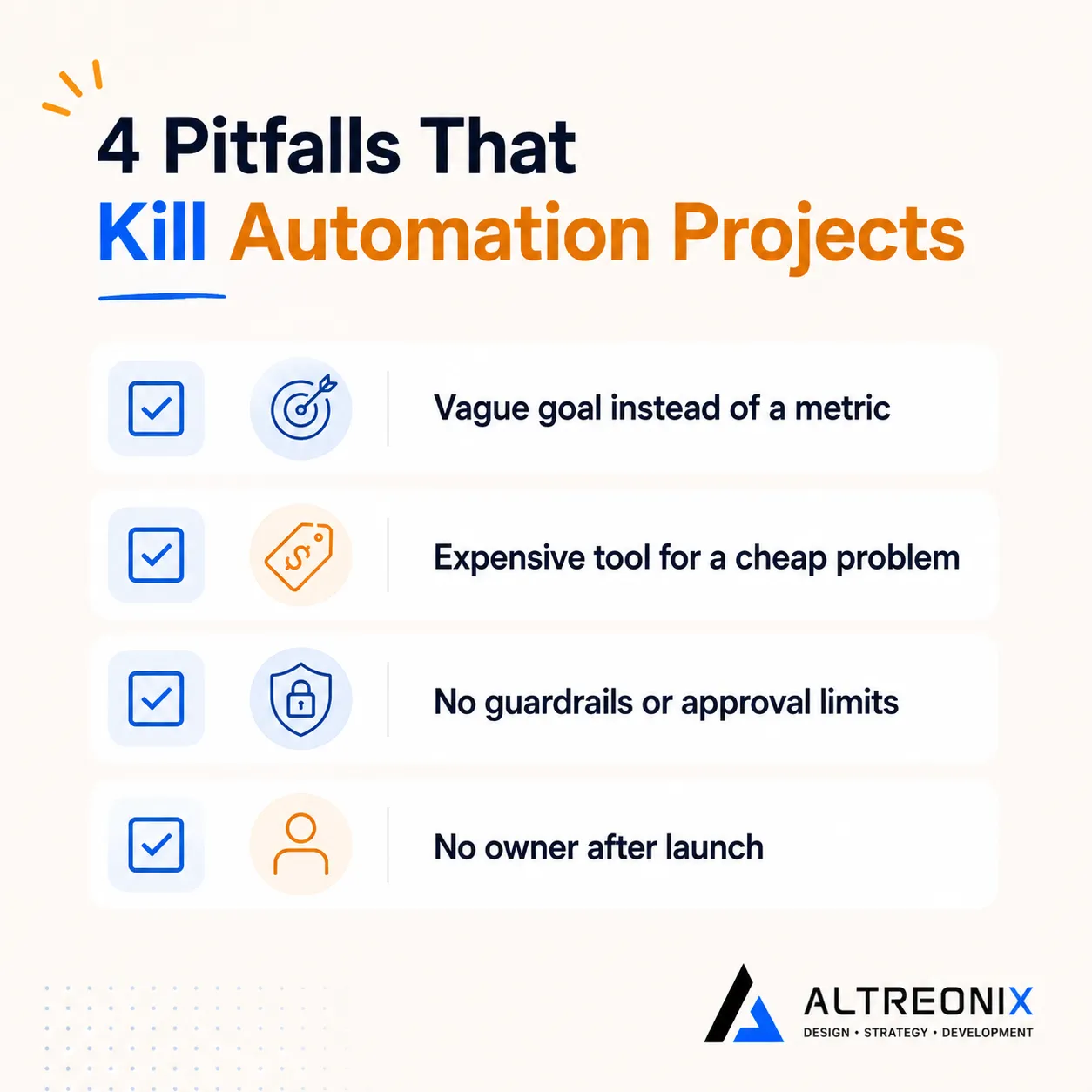
“We should use AI” is not a project. It’s a mood. And mood-driven projects are disproportionately the ones that get quietly shelved once the initial excitement wears off.
A real project looks like “cut average response time on billing questions from four hours to under thirty minutes” or “reduce invoice reconciliation errors by half.” Those are specific enough that you can tell, three months in, whether it worked. “We should use AI” gives you nothing to measure against, which means nobody can ever prove it succeeded, and nobody can catch it early when it’s failing.
This is exactly the failure mode analyst coverage keeps flagging: unclear business value and weak measurement sit right alongside cost overruns as the top reasons agentic projects get cancelled. The fix costs nothing and takes about twenty minutes: before you build anything, write down the one metric that will tell you whether this worked, and the specific workflow it applies to. If you can’t do that, you’re not ready to build yet, you’re ready to go pick a workflow.
Trap 2: Buying the Expensive Tool for a Problem That Needed a Cheap One
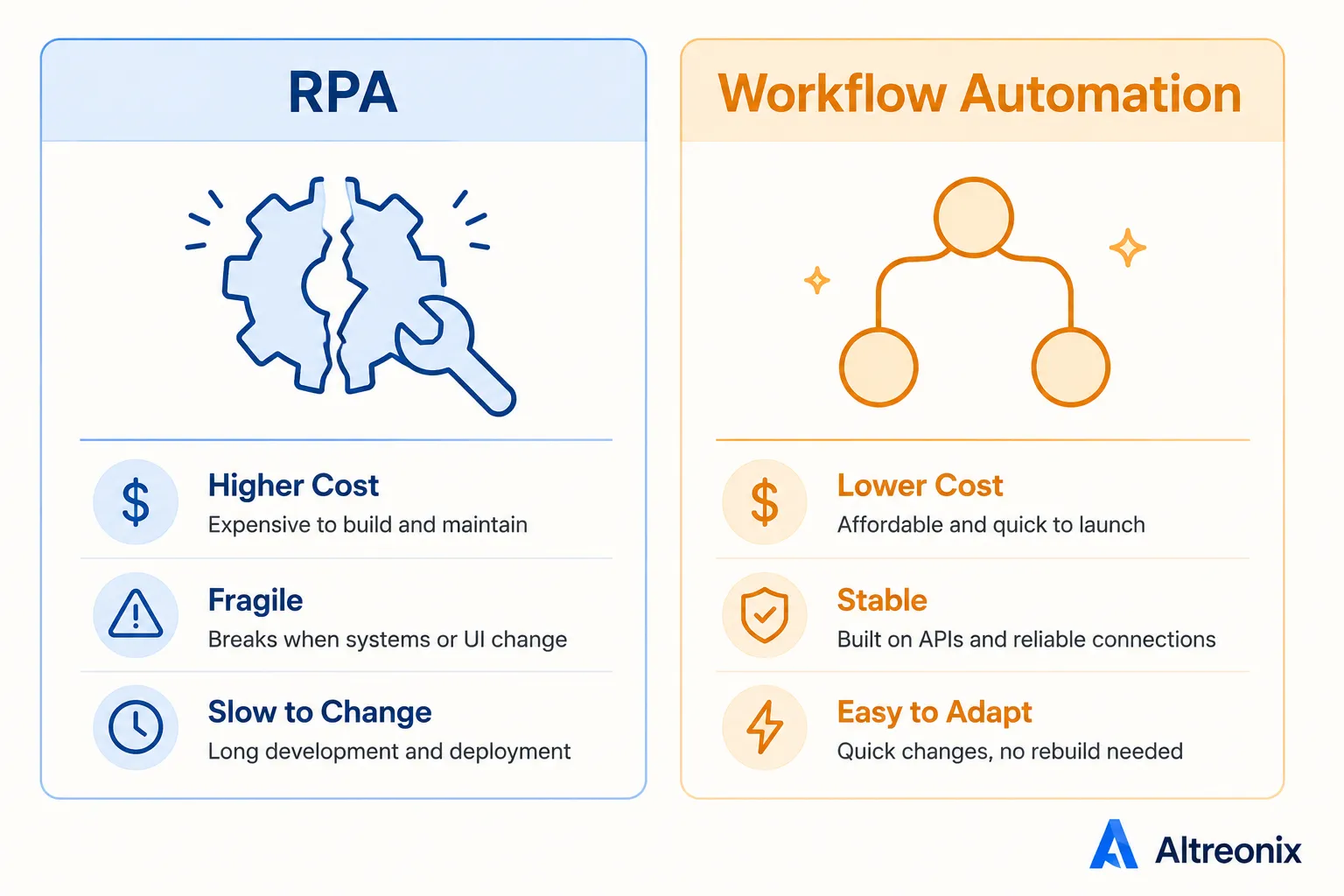
This is the one we see most often, and it’s almost always a case of RPA or a custom agent getting bought for a process that a plain workflow automation, or even a redesigned manual process, could have handled for a fraction of the cost.
RPA in particular gets over-applied. It exists to solve one specific problem: automating a system that has no API to connect to. Outside of that narrow case, it’s usually the more expensive, more fragile option compared to an API-based integration. Enterprise data backs this up starkly: spending on RPA crossed well into the billions in 2025, yet a large share of those deployments stall or fail to scale, largely because bots got bolted onto processes that were never redesigned to begin with rather than fixed at the root.
 The same over-buying pattern shows up with agents. A business will build a full agentic system for a task that happens six times a month and has almost no ambiguity in it, when a two-step Zapier flow would have done the job at a tenth of the cost and none of the risk. The tell is usually simple: if you can write the steps down as an unambiguous list and they don’t change, you didn’t need an agent, you needed automation.
| Trap | What it looks like | The cheaper fix |
|---|---|---|
| RPA for a modern SaaS process | Bot clicking through a CRM UI that has a perfectly good API | API-based workflow automation |
| Agent for a fixed-steps task | An agent “deciding” something that never actually varies | A simple trigger-and-action automation |
| Custom build for a solved problem | Bespoke agent for lead routing your CRM already does natively | Turn on the existing feature first |
Trap 3: No Guardrails, So One Mistake Gets Expensive Fast
An agent with no approval thresholds, no logging, and broad permissions isn’t a small risk waiting to happen. It’s a large one, just one that hasn’t happened yet.
This trap is different from the first two because it’s not about wasted budget, it’s about exposure. An agent that can move money, change pricing, or commit to a customer without a human checkpoint will eventually do something you didn’t intend, not because it’s malicious, but because edge cases exist and models make mistakes under ambiguity. The businesses that get burned here usually had the exact same warning signs beforehand: shared admin logins, no record of what the agent actually did or why, and permissions scoped far wider than the task required. This is precisely the pattern analyst research on agentic AI keeps pointing to as a top failure driver, alongside the cost and value issues from Trap 1.
The fix isn’t complicated, it’s just easy to skip when you’re excited to launch:
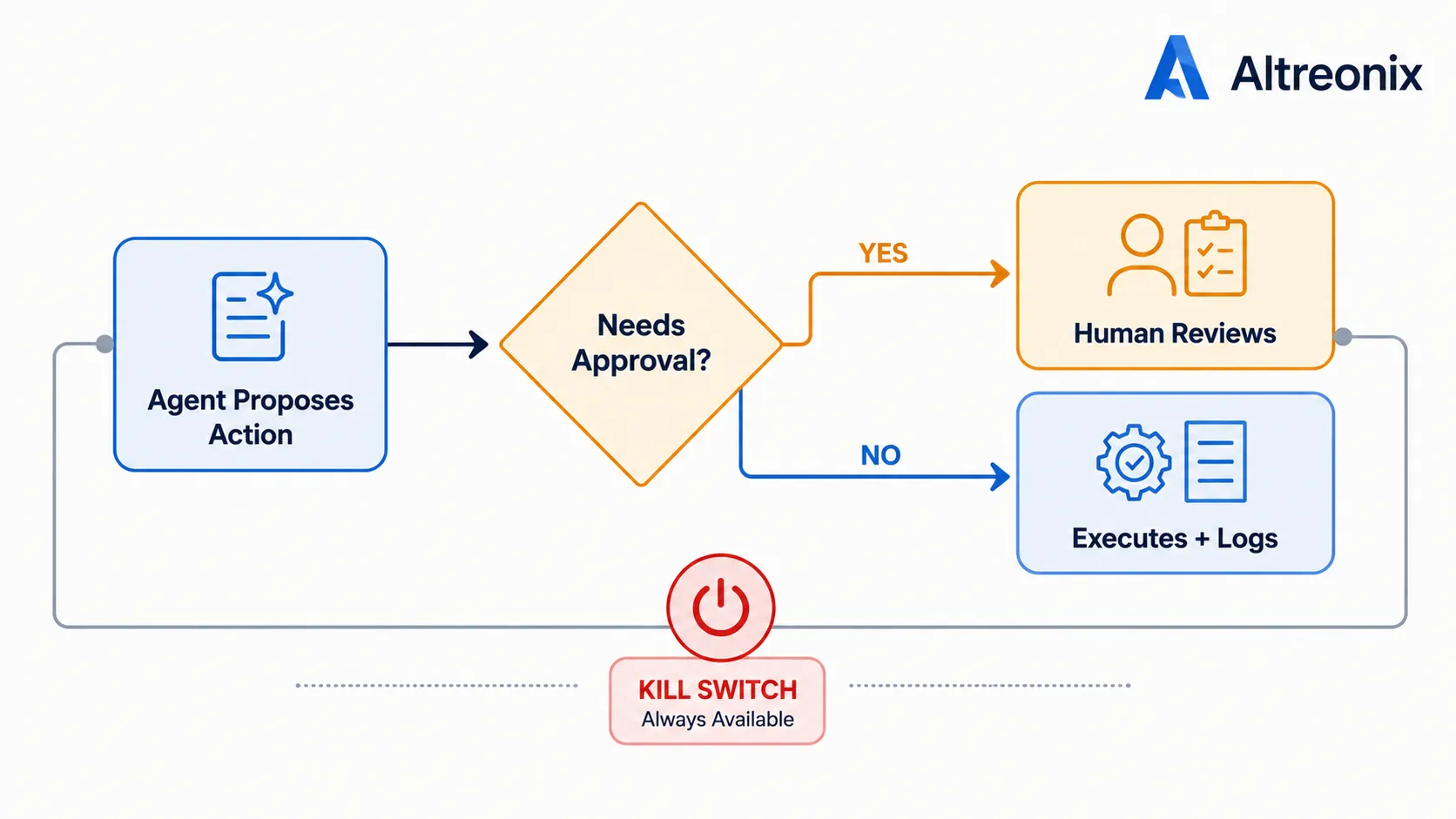
- Least-privilege access. The agent gets exactly the permissions the task needs, nothing more.
- Approval thresholds. Anything involving money, legal terms, or a customer-facing commitment gets a human sign-off before it executes.
- Logging. Every action the agent takes is recorded somewhere you can actually review.
- A kill switch. One clear, fast way to shut it off completely if something looks wrong.
None of these are optional once an agent touches anything with real downside. They’re the difference between a contained mistake and an expensive one.
Trap 4: Nobody Owns It, and Nobody Trained For It
This trap is quieter than the other three, but it’s just as common. A business builds a genuinely good automation or agent, launches it, and then nobody on the team actually knows how to adjust it, monitor it, or explain it to a new hire six months later. The person who built it moves on, and the system slowly becomes a black box nobody trusts enough to rely on or touch enough to improve.
 This is a change management failure, not a technical one, and it’s easy to miss because the launch itself often looks successful. The signs to watch for:
- No single person is responsible for checking whether it’s still working as expected.
- The team was never actually shown how it works, just told “it’s automated now.”
- Nobody’s tracking the metric you set in Trap 1, so a slow decline in performance goes unnoticed for months.
The fix is unglamorous: name an owner, even if it’s a part-time responsibility, and put a recurring thirty-minute check on the calendar to look at the metric and the logs. That’s genuinely most of what prevents this trap.
A Quick Self-Audit Before You Build Anything
If you’re about to greenlight an automation or agent project, run it through these four questions first. If you can’t answer all four cleanly, you’re not ready to build yet.
- What’s the one metric that tells us this worked or didn’t?
- Could a cheaper tool (automation instead of RPA, automation instead of an agent) handle this just as well?
- What’s the worst thing that happens if this makes a mistake, and what stops that from happening?
- Who owns this after launch, and when do they check on it?
We use a version of this exact checklist with clients before we recommend building anything, agent, automation, or otherwise. It catches more problems in twenty minutes than most post-launch reviews catch in six months.
How We Approach This With Clients
 Our starting point is never “let’s add an agent” or even “let’s automate this.” It’s mapping the workflow itself and running it through the four traps above before we touch a build. In practice, that means we’re often talking a client out of the more expensive option, recommending a straightforward workflow automation where they came in expecting to need something more elaborate. Where an agent genuinely earns its place, our AI solutions work builds the guardrails in from the start, approval thresholds, logging, and a named owner, rather than treating them as an afterthought once something’s already gone wrong.
Where to Go From Here
None of these four traps are exotic. They’re the same handful of setup mistakes showing up again and again across failed projects, and every one of them is avoidable with about twenty minutes of upfront thinking. Vague goal, wrong tool for the job, no guardrails, no owner. Check those four boxes before you build, and you’ve already avoided most of what sinks these projects.
If you’re not sure which of these traps your own plans might be walking into, that’s exactly the kind of gut check we do with clients before recommending anything. Take a look at our AI solutions work, or reach out and we’ll walk through your specific setup together.