Introduction
Ask this question out loud and you'll get an answer that ranges from "a few hundred dollars" to "well into six figures." Both answers are technically true. Neither is useful.
Clutch's most recent small business research found that 83% of small businesses now have a website, up from 64% in 2018. The cost of getting one built has never been more visible, and never been more confusing to pin down. So we went looking for the real number, reading through agency pricing pages, global cost surveys, conversion research from Google and Deloitte, and CMO budget data, instead of repeating whatever figure ranks highest on Google.
Here's what we found, and why the price tag was never the most important part of the answer.
1. The Number Everyone Is Afraid to Give You
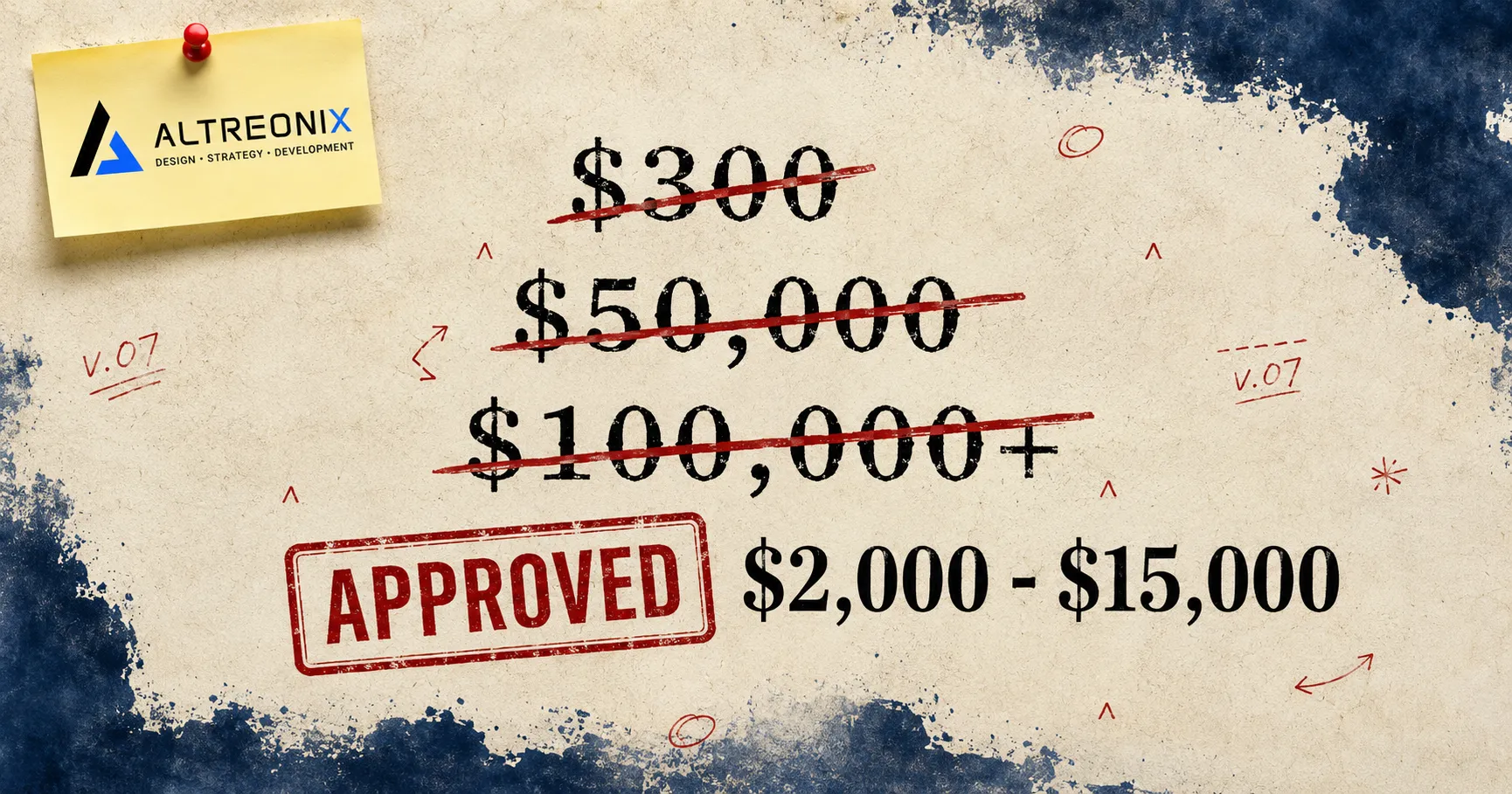
For most small businesses, professional firms, and growing B2B companies, a properly built website lands somewhere between $2,000 and $15,000.
Not $300. That number belongs to a template, not a website built around how your business actually sells.
Not $50,000, either. That's enterprise territory, and most businesses asking this question aren't there yet.
GoodFirms' 2026 survey of 300+ web development firms across 31 countries puts a finer point on it: 63% of agencies quote fixed-price projects somewhere between $1,000 and $15,000, with the heaviest concentration sitting between $5,000 and $20,000 once you move past a bare-bones build. Here's roughly where the market sits today.
Build Type | Typical Range |
|---|---|
AI website builders | Under $1,500 |
Freelancers / basic builds | $1,000 - $5,000 |
Small-to-mid agencies (full marketing site) | $5,000 - $20,000 |
Specialist studios / custom web apps | $20,000 - $50,000+ |
Enterprise builds | $50,000 - $500,000+ |
The exact figure still depends on scope, region, content, and how much functionality you actually need. But the surprising part of this research wasn't the pricing. It was how little the price alone tells you about what you're going to get.
2. How We Got Here
Most "how much does a website cost" articles lean on one or two sources. We didn't want to do that, so this piece pulls from agency pricing benchmarks, Clutch's 2025 small business website research, GoodFirms' 2026 cost survey, Google and Deloitte's "Milliseconds Make Millions" study, Google's Core Web Vitals business impact case studies, Gartner's CMO budget research, and Adobe's Digital Trends report.
We expected a clean average to fall out of all that data. It didn't. Different surveys, different agencies, different regions, all landed on different numbers.
What was consistent wasn't the price. It was the behaviour of the websites that actually performed: fast, mobile-first, clearly written, planned before a single screen was designed.
3. The Finding That Mattered More Than the Price Tag
A website can be cheap to build and expensive to own.
Most pricing conversations end at the invoice. Almost none of them touch the cost of a website that simply doesn't work, the leads it never generated, the visitors who bounced before they read a sentence.
GoodFirms' research puts an actual number on this: the real two-year cost of a professionally built website typically runs 150% to 200% of the original build invoice once hosting, maintenance, content updates, and integration upkeep are factored in. That's not a markup nobody told you about. It's the ongoing cost of owning something that has to keep working, on every device, for years.
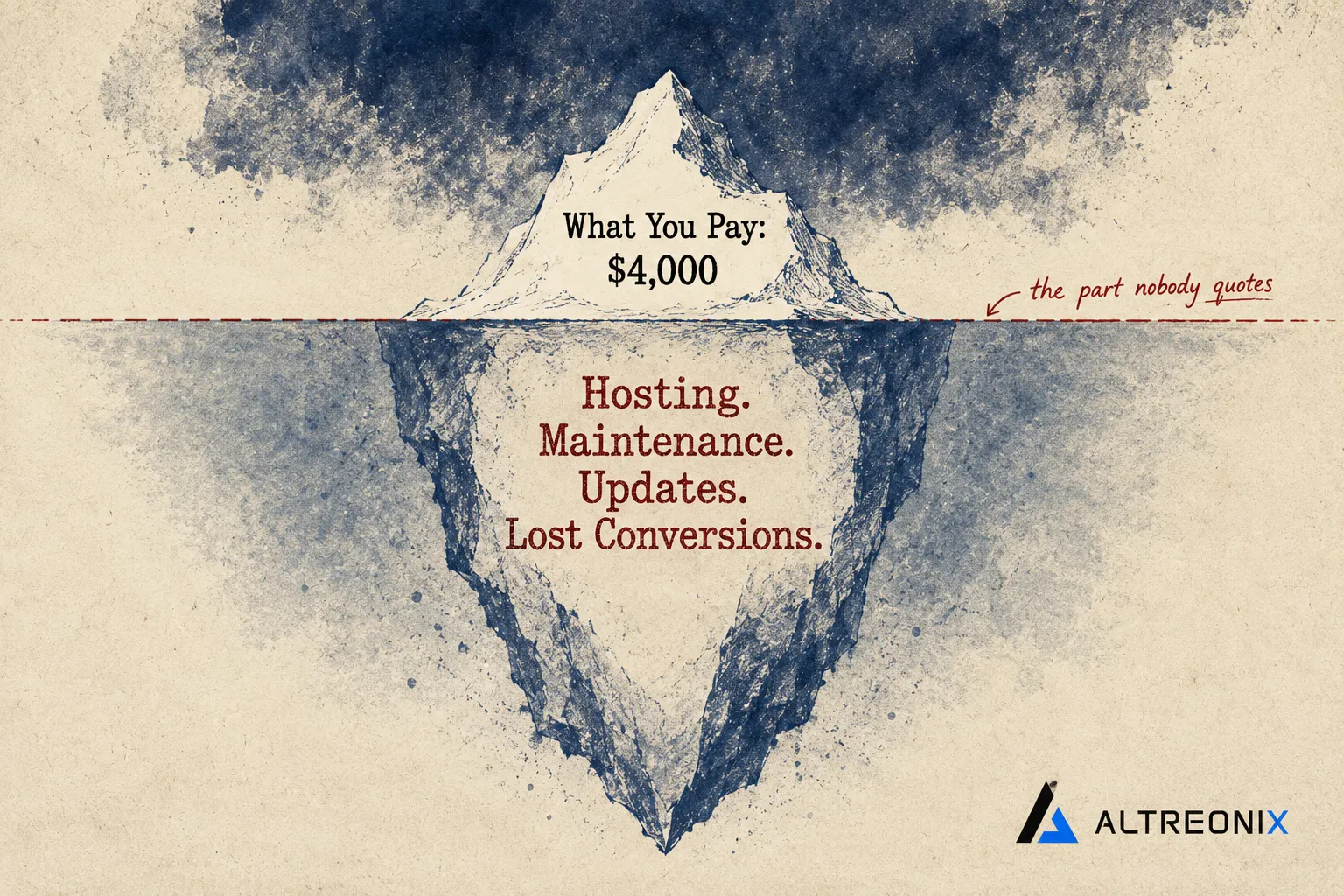
Picture two businesses, each spending $4,000. One ends up with a site that loads fast, explains what it does in plain language, and converts visitors into enquiries. The other ends up with something that looks fine, loads slowly, and quietly produces almost nothing.
Same invoice. Completely different business outcome. The real cost of a website was never what you paid for it. It's the revenue you didn't generate because of how it was built.
4. Why Two Businesses Can Spend the Same Money and Get Different Results
The gap between a $2,000 website and a $10,000 website is rarely page count. It's process, and GoodFirms' phase-by-phase budget data backs this up directly.
4.1 What the Low End of the Market Skips
At the bottom of the market, the line items that tend to disappear first are discovery and planning, content strategy, copywriting, conversion thinking, and any real performance work. GoodFirms found that discovery and planning typically absorb only 5% to 10% of a project's budget, and one of their own FAQ findings is blunt about what happens when that gets skipped: it's the single most reliable way to end up with scope creep and a budget that grows mid-project.
4.2 What the High End Is Actually Paying For
Higher up the market, you're not paying for more pages. You're paying for more thinking before anything gets designed: more time understanding the business, more rigor on what the site needs to do, more refinement once it's live. Whether that's worth it depends entirely on how much revenue is actually riding on the site doing its job.
5. What the Performance Data Actually Shows
This is where the research got genuinely interesting, because the numbers on speed and clarity are far more concrete than anything in the pricing data.
Google and Deloitte's "Milliseconds Make Millions" study tracked 37 retail, travel, luxury, and lead-generation brands across 30 million mobile sessions. A 0.1-second improvement in load time was enough to lift retail conversions by 8.4% and travel conversions by 10.1%, with retail customers also spending close to 9% more per session. That's the effect of a tenth of a second.
Google's own Core Web Vitals case studies tell the same story at company scale. Vodafone improved page-load speed by 31% and saw an 8% lift in sales. Tokopedia cut load time roughly in half and saw a 23% increase in average session duration. Redbus's speed fixes contributed to an 80 to 100% increase in mobile conversion rates across its global markets.
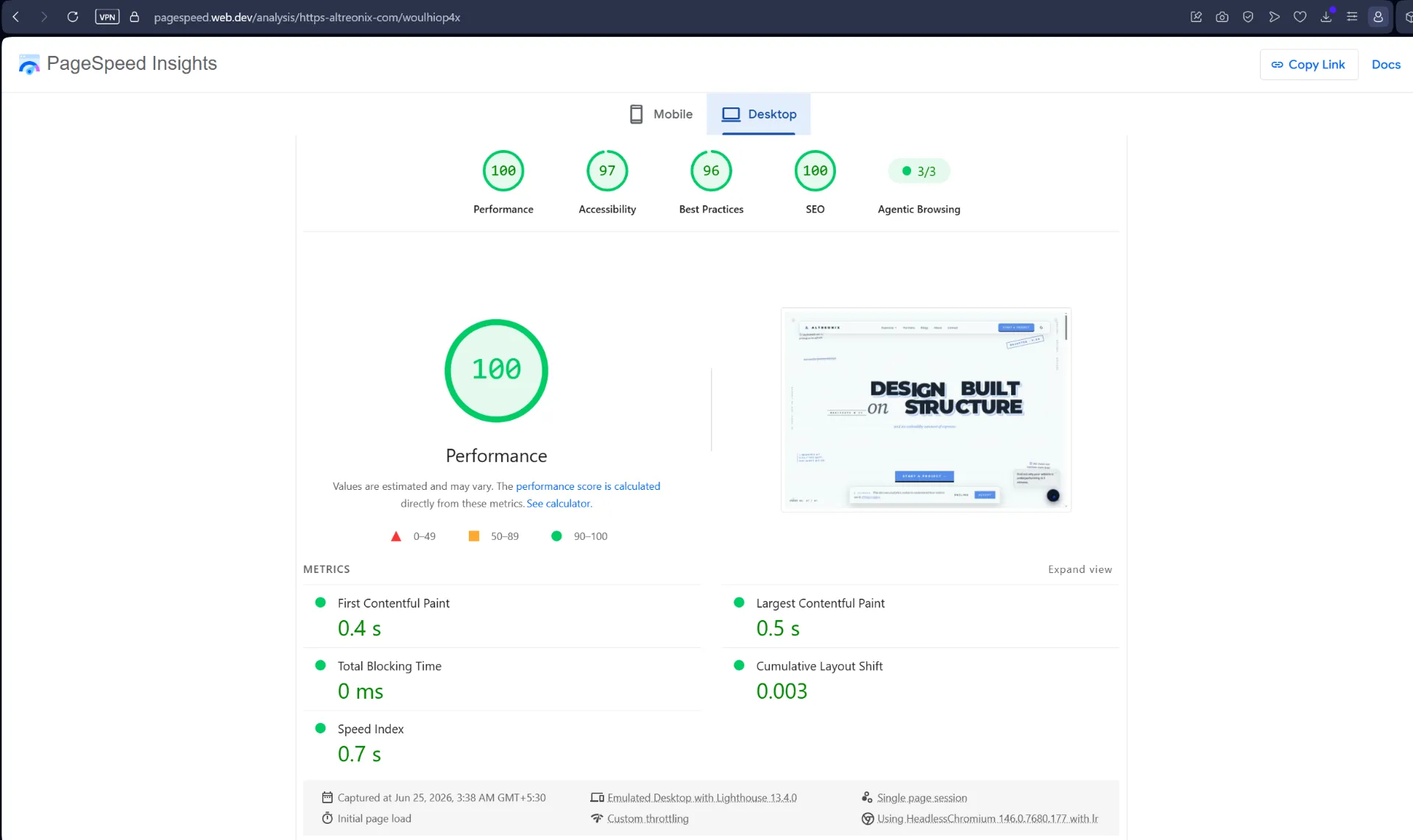
We're not citing this from the sidelines. Run Altreonix.com through PageSpeed Insights right now and the desktop report comes back at 100 for Performance, 100 for SEO, 97 for Accessibility, with a 0.5 second Largest Contentful Paint. If the data above says speed moves the needle, here's where we sit on it.
None of this shows up on an invoice. It shows up in whether the website actually does the job it was built to do, and separately, Adobe's most recent Digital Trends research found that only about a quarter of consumers describe their digital experience with a brand they already deal with as excellent. The gap between "looks fine" and "actually works" is where most of the value gets lost.
6. What Actually Blows Up a Website Budget
Forget the platform. The reasons projects run over budget or underdeliver are rarely technical.
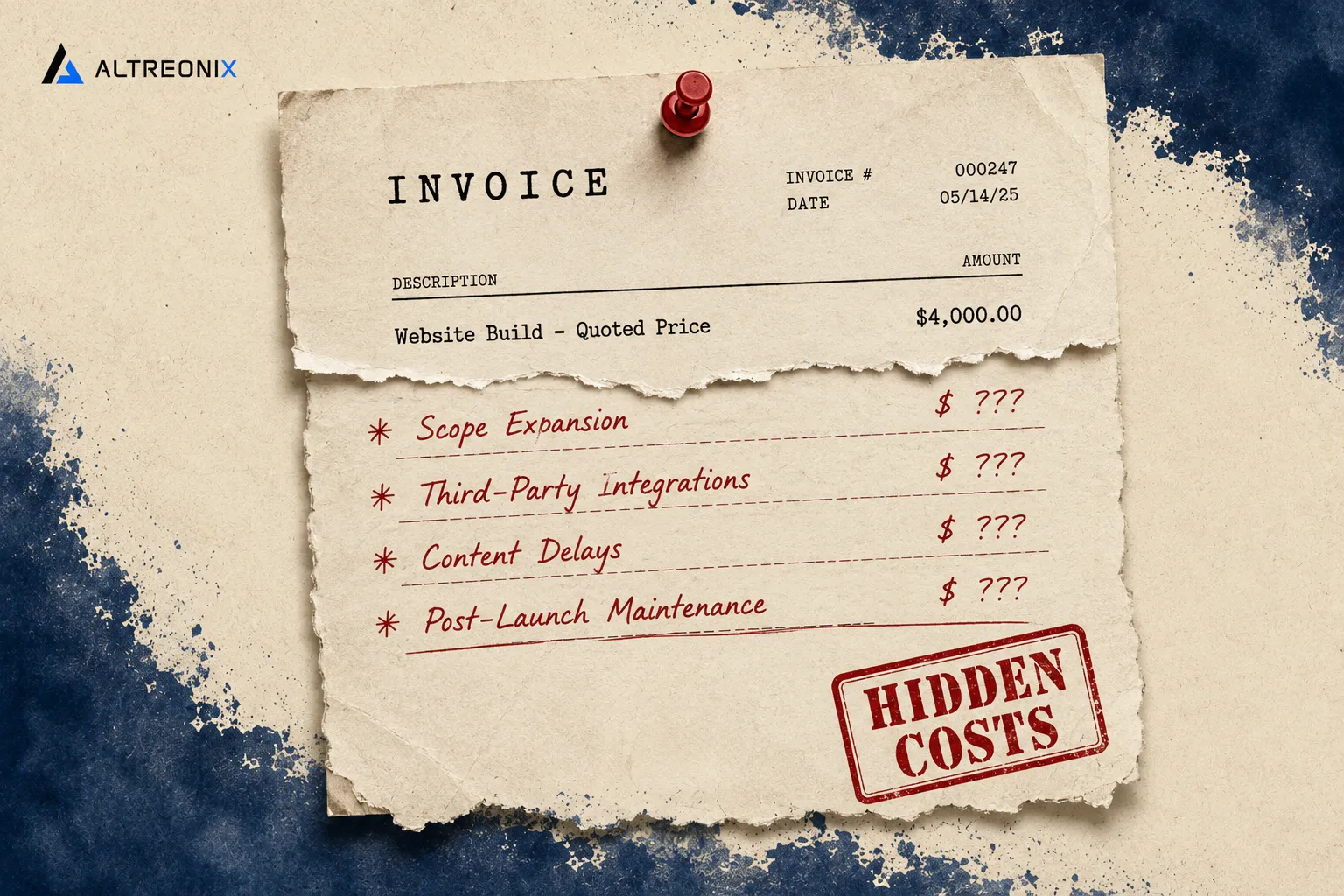
GoodFirms asked agencies directly what pushes a project past its original quote. Custom backend development topped the list, followed by AI and automation features, then client revisions cited by nearly half of respondents. Underneath that sit the costs nobody puts in the original quote: scope expansion, third-party integrations that turn out to need custom work, content that arrives late, and SEO or compliance work that gets pushed to "phase two" and ends up costing more once it's bolted on after launch.
A disciplined process on an ordinary platform will consistently outperform a chaotic process on the most modern stack available. Picking the right partner matters more than picking the right tech.
7. Four Questions Worth Asking Before You Sign Anything
Before you compare a single price, get straight answers to these.
7.1 What Problem Are We Actually Solving
Not a general answer about "a modern website." A specific answer about what this site needs to do for your business, in your market, that it currently isn't doing.
7.2 What Happens Before Design Starts
If discovery, content strategy, and performance planning aren't part of the answer, they're probably not part of the scope either, and you'll feel that absence later, not now.
7.3 How Is Mobile Handled, Specifically
Most of your traffic is already arriving on a phone. How the site behaves on one isn't a finishing touch. It's a core requirement, and it should be treated like one from the first wireframe.
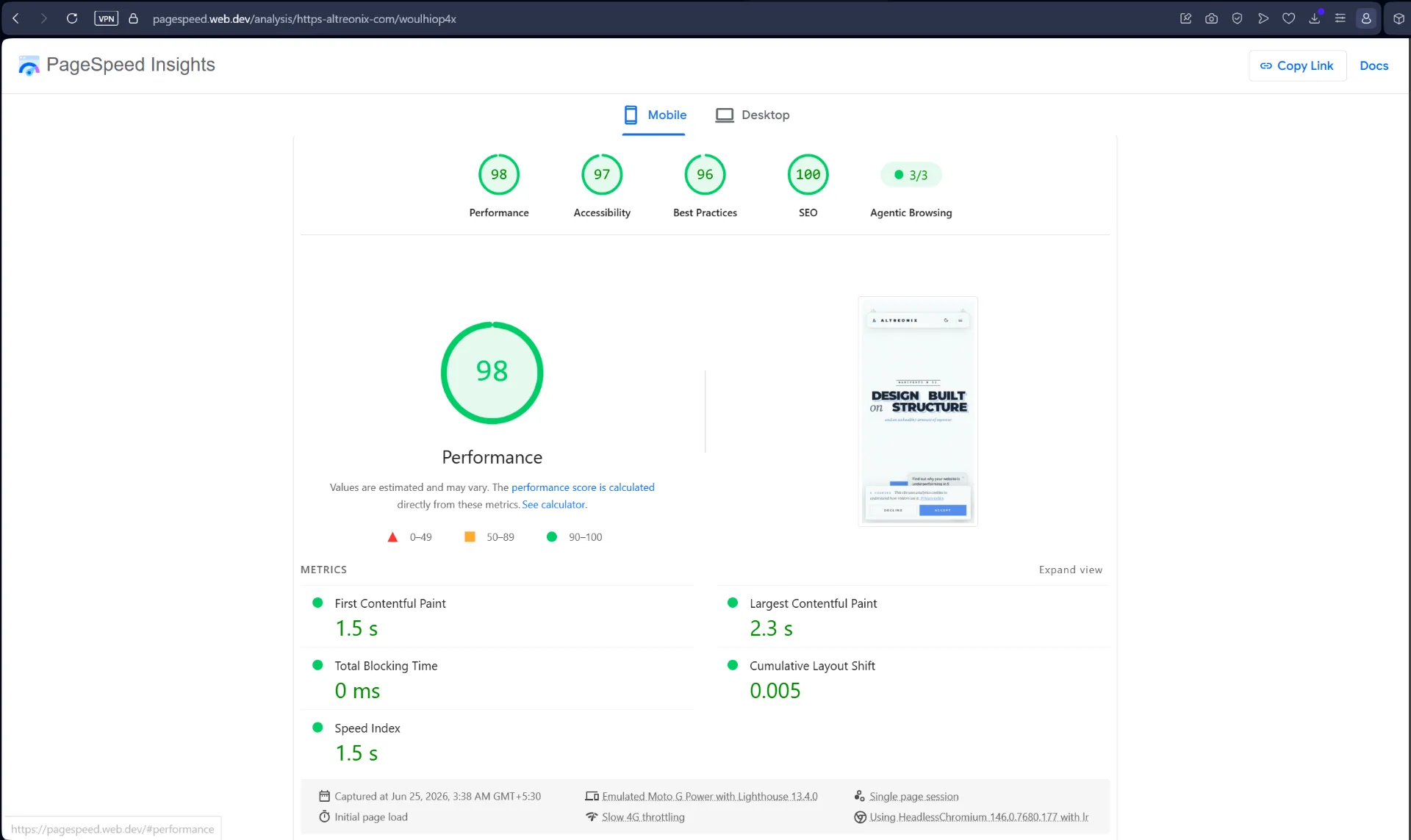
We hold our own build to that bar. Altreonix.com scores 98 for mobile performance on PageSpeed Insights, with a 2.3 second Largest Contentful Paint on a throttled mid-range Android device, not a flagship phone on good wifi. That's the version of the site most people are actually loading.
7.4 What Does Support Look Like After Launch
Most proposals have no clean answer here. Find out before you've signed anything, not after the site is live and something breaks.
If you want a sense of where your current site stands before any of these conversations, run it through our free site diagnostic. It won't tell you what to spend on a new build. It will tell you exactly what your current one is costing you.
8. The Short Version
If you're looking for a direct answer, a professionally built small business website in 2026 typically costs between $2,000 and $15,000.
That's the short answer. The more useful answer is that cost alone rarely determines the outcome.
After reviewing 56 sources, one pattern appeared consistently: businesses that get the best results focus on the factors that actually drive growth.
That means clear messaging, thoughtful planning, strong performance, and a website built around customer actions rather than aesthetics alone.
The highest-performing websites are not always the cheapest or the most expensive.
They're the ones designed to turn visitors into customers.