
Every 10 to 50-person business we’ve talked to has some version of the same story. A budget approval sits in an email thread for four days because the one person who can sign off is traveling. A vendor payment gets approved twice by two different people who didn’t see each other’s replies. An HR request for a new hire gets lost between three different Slack channels and has to be re-sent from scratch.
None of that is a communication problem. It’s what happens when a workflow, something with steps, a hierarchy, and a required outcome, gets run through tools built for conversation, not process. Email and chat are excellent at communication. They have no real concept of “status,” no enforced order of operations, and no permanent record of who approved what and when. At a certain point, usually right around 10 to 50 employees, that gap stops being a minor annoyance and starts being a real operational cost.
The Real Cost of Manual Approvals
The most visible cost is the delay itself. Whatever depended on that approval, a purchase, a hire, a budget release, sits waiting the entire time the request is stuck in someone’s inbox. Analyses of SME financial management found that 36% of small and mid-sized businesses report payment delays tied directly to manual approval chains, a number that tracks closely with what we hear from operations leads directly.
The less visible cost is compliance and audit risk. Manual approval processes routed through email and chat tools typically leave no structured record of the decision, just a buried thread that may or may not still exist by the time anyone needs to check it. For finance and HR approvals specifically, that’s not just inefficient, it’s a real exposure if a decision ever needs to be reconstructed for an audit or a dispute.
Then there’s the bottleneck cost, which compounds the other two. Small business operations research on approval processes shows that once a team crosses roughly 10 employees, the number of approvals flowing through informal channels grows faster than the team’s ability to track them manually, which is exactly the point where “we’ll just handle it over email” stops scaling.
Here’s what that actually looks like on a normal Tuesday. A vendor invoice needs sign-off before Friday’s payment run. The request goes out over email to the department head, who’s traveling and doesn’t see it until Thursday afternoon. Meanwhile, someone else on the team, unsure whether it was already approved, forwards the same invoice to finance a second time. Now finance has two versions of the same request, no clear record of which one is current, and a payment that’s either going to miss the run entirely or get processed twice. None of this happened because anyone did their job poorly. It happened because the process had no defined owner, no visible status, and no fallback when the primary approver was unavailable.
What a Good Approval Workflow Actually Looks Like
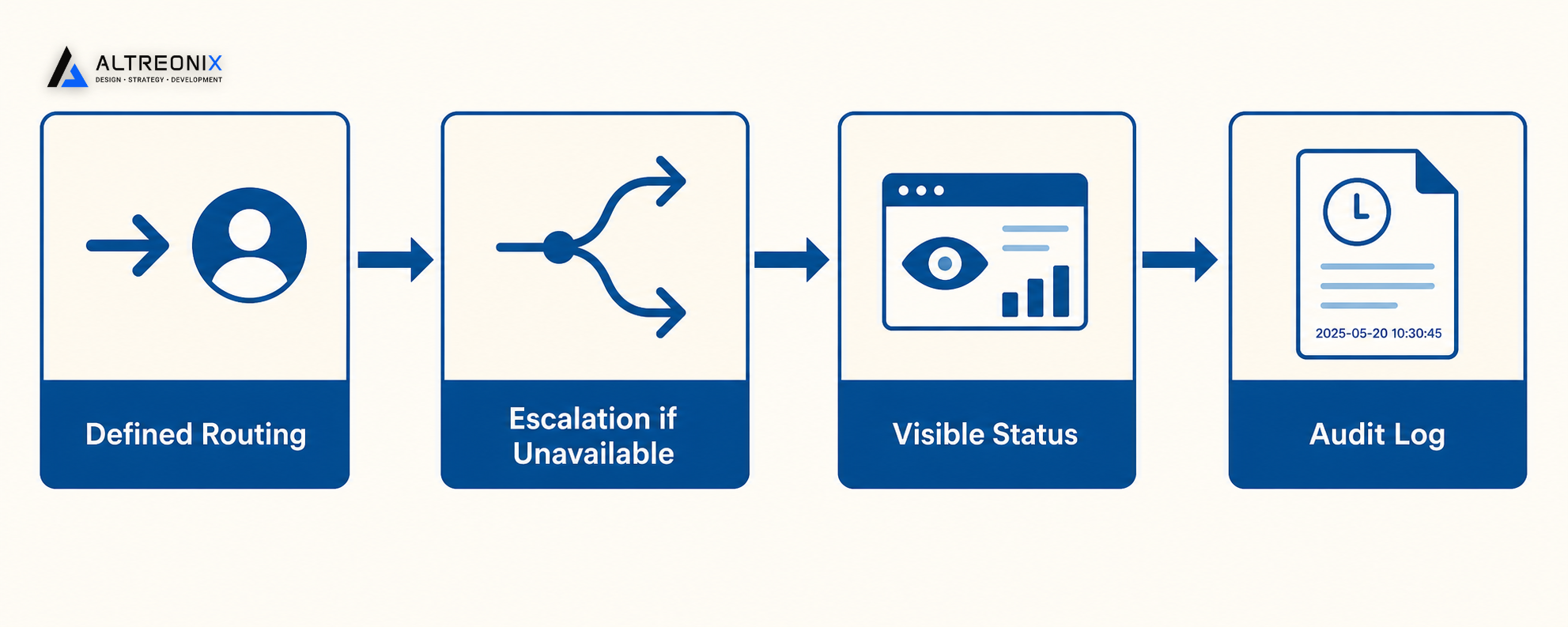
A properly built approval workflow isn’t more complicated than an email thread, it’s just structured differently. Effective approval workflows share a few consistent characteristics regardless of the specific tool used to run them:
- Defined routing. The request goes to the right approver automatically, based on the type of request and its amount, rather than depending on someone remembering who to CC. This alone eliminates the double-approval and missed-request problems that show up constantly in email-based processes.
- Clear hierarchy. If the first approver is unavailable, the request escalates to someone who can act, instead of sitting untouched until that person happens to check their inbox. This is the single fix that would have prevented the vendor invoice scenario above.
- A visible status. Anyone involved can see whether a request is pending, approved, or rejected without having to ask, which removes the “did anyone see this?” follow-up messages that quietly eat into everyone’s day.
- A permanent audit log. Every decision is timestamped and attributed, so reconstructing “who approved this and when” takes seconds, not an afternoon of searching old threads, and holds up if a decision ever needs to be reviewed later.
None of this requires enterprise software. It requires treating approvals as a workflow with defined steps, rather than a conversation that happens to end in a decision.
The Four Types of Approvals Worth Systemizing First
Not every approval in your business needs the same level of structure right away, and trying to formalize all of them simultaneously is usually where these projects lose momentum. These four categories cover most of what actually causes friction at the 10 to 50-employee stage, and they tend to break down in fairly predictable, distinct ways:
| Approval Type | Typical Trigger | What Breaks Without a System |
|---|---|---|
| Finance | Budget requests, expense reimbursements, purchase orders | Payment delays, duplicate approvals, no spend visibility |
| HR | New hire requests, role changes, time-off exceptions | Lost requests, inconsistent handling across departments |
| Procurement | Vendor payments, contract sign-offs, purchase thresholds | Missed thresholds, no audit trail for compliance |
| Operational changes | Process updates, access changes, policy exceptions | Inconsistent application, no record of who approved a change |
Most businesses don’t need to systemize all four at once. Picking the category causing the most visible pain right now, usually finance or procurement given how directly they touch cash flow and vendor relationships, is a better starting point than trying to build one workflow that covers everything from day one. Once that first category is running smoothly, the pattern for the next one is almost always faster to set up.
Your Options: Off-the-Shelf Tools, E-Signature Platforms, or Lightweight Custom Workflows
The right tool depends heavily on how standardized your approval process already is versus how much it varies by request type. Getting this choice wrong in either direction is where a lot of these projects waste money, either paying for a full platform to solve a problem three form fields would have handled, or trying to force a genuinely irregular process into a rigid tool and living with the workarounds.
Off-the-shelf approval workflow tools work well when your process is fairly standard, a defined chain of approvers, clear thresholds, and not much variation between request types. Dedicated approval workflow platforms typically handle routing, escalation, and audit logs out of the box, without requiring custom development, which makes them the fastest path for a business with straightforward, repeatable approval logic.
E-signature platforms are worth layering in specifically for approvals that need a legally binding signature, contracts, HR documents, vendor agreements, rather than just a status change. These solve a different problem than routing and shouldn’t be treated as a substitute for a full approval workflow, they’re a piece of one.
Lightweight custom workflows, often built with a tool like n8n connecting a simple form to email notifications and a status tracker, make sense when your approval logic has enough exceptions or business-specific rules that an off-the-shelf tool would require constant workarounds. This path also tends to be the cheapest starting point for a single, well-scoped approval type, since it doesn’t require adopting an entire new platform, and it scales naturally as you add the next workflow.
A Step-by-Step Path: From Approval Matrix to Working Pilot
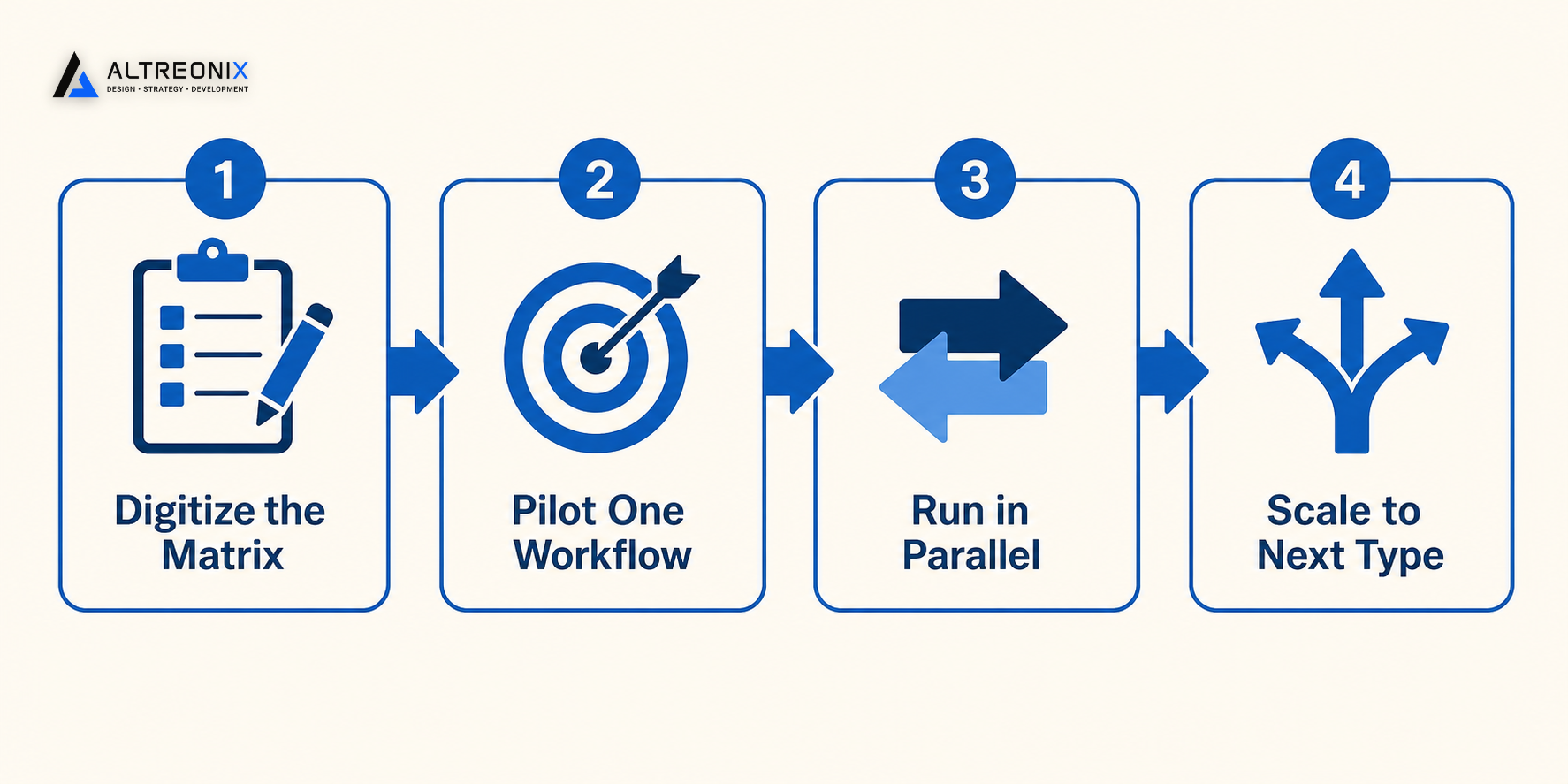
Trying to formalize every approval process in the business at once is the most common way these projects stall. A narrower, staged approach works better:
- Digitize your approval matrix first. Write down, for each approval type, who approves what, at what threshold, and who the backup approver is. Most businesses have never done this on paper, and doing it surfaces gaps, missing backups, unclear thresholds, before any software gets involved. This step alone often prevents the exact scenario described earlier, where nobody’s sure who’s actually supposed to sign off.
- Pick one low-risk workflow to pilot. Choose an approval type with clear rules and low stakes, expense reimbursements are a common starting point, rather than something complex and high-stakes like vendor contracts. A low-risk pilot lets you work out the routing logic without the pressure of a high-value decision riding on getting it right the first time.
- Run the pilot workflow for a few weeks alongside the existing email process, so you can catch gaps in the routing or escalation logic before removing the fallback. This is where you’ll find the exceptions your matrix didn’t account for, the approval that needs two sign-offs instead of one, or the request type that doesn’t fit neatly into any category.
- Scale to the next approval type once the pilot is holding up, using what you learned about routing and exceptions to make the next rollout faster. Each additional workflow tends to take less time than the last, since the underlying structure is already proven.
How Approvals Connect to Your Other Systems
Approvals rarely function in isolation. A budget approval often needs to reflect in your finance records. An inventory reorder approval connects directly to the inventory system tracking stock levels in the first place. An HR approval for a new hire kicks off onboarding. Building approvals as an isolated fix, disconnected from the systems they actually feed into, tends to just relocate the manual reconciliation problem rather than solve it. This is part of why we think about approvals as one piece of the broader operational systems picture rather than a standalone software purchase.
If budget, HR, or vendor approvals are currently living in email threads and group chats, it’s worth a focused look before the next delay or compliance gap costs more than the fix would have. We offer an Approvals Workflow Audit, where we review one core approval process and propose a simple, low-risk system design built around how your team actually works. Get in touch here and bring whichever approval chain causes the most headaches right now.